
What a show CPHI Frankfurt 2025 was! As one of the pharma industry’s flagship events, CPHI never fails to showcase the forces shaping global pharmaceutical development. As the BDB team has been reflecting on this year’s show, one thing is clear – in a market now defined by rising uncertainty alongside scientific advances, the B2B brands that communicate with clarity, credibility, and distinctiveness will be the ones that break through. From the explosion of weight management and obesity drugs to the ascent of contract development and manufacturing organisations (CDMOs), this blog explores the key pharma trends we observed on the show floor. Plus, practical tips and strategic advice that B2B marketing teams can use to stand out in an increasingly crowded landscape.
Therapeutic shifts reshaping the market
Attend a pharma conference today and you’ll likely see reference to glucagon-like peptide-1 receptor agonists (GLP-1s). The weight management category has come to the fore, with drugs like Wegovy and Mounjaro transforming not just waistlines but entire market dynamics. With approximately nine drug candidates in Phase III and around 80 in earlier stages, innovation in this space is not slowing down.1
As these lifestyle medications rise in popularity, the lines between pharmaceuticals and nutraceuticals become increasingly blurred – a trend that we have been observing for some years now. With the FDA overseeing both markets in the US, we’re seeing genuine convergence – creating a unique communications challenge for brands that need to speak credibly to both patients and consumers simultaneously and presenting opportunity for companies with cross-sector expertise.

While these therapeutic shifts play a role in shaping the pharma landscape, biologics still dominate the pipeline with three times more approvals than small molecules (in percentage terms).2 This is driving a fundamental change in production demand – from traditional high-volume manufacturing to facilities that are designed for flexibility rather than pure scale. Yet without supply chain resilience, even the best manufacturing strategy falls short – bringing us to the next major trend we observed at CPHI.
Uncertainty and supply chain transparency
One speaker at CPHI perfectly summed up the state of the industry as the end of 2025 draws near: “Science built pharma. Now geopolitics, economics, and patients’ needs redefine it”.2 The market is operating in what the speaker called ‘VUCA conditions’ – volatility, uncertainty, complexity and ambiguity. Walking the show floor, uncertainty was a prominent topic of conversation. Several conference presentations and panel discussions centred on the impact of US administration policy shifts, escalating tariffs, export controls, cybersecurity risks and so on.
In this environment, brands must demonstrate resilience and transparency, which also aligns with increased interest in ethical sourcing and sustainability. As a result, the supply chain has become a narrative asset. Audiences want to hear about dual sourcing of raw materials, geographic diversification, nearshoring strategies and – perhaps most tellingly – maintaining strategic inventory despite financial pressure. 3 As one speaker put it, inventory must be seen as essential insurance against supply chain disruptions.3
Partnership takes on new meaning: the age of CDMOs
Another impossible-to-miss observation from the show floor was the increased presence of CDMOs compared to previous years. As precision medicines require increasingly specialised, modular manufacturing capabilities, pharma companies are embracing outsourced partnerships for both strategic and tactical reasons. CDMOs offer risk diversification (spreading regulatory and supply chain exposure), access to specialised crisis management capabilities and capital efficiency.
However, within this sea of CDMOs lies several opportunities for B2B marketers to create stand out.
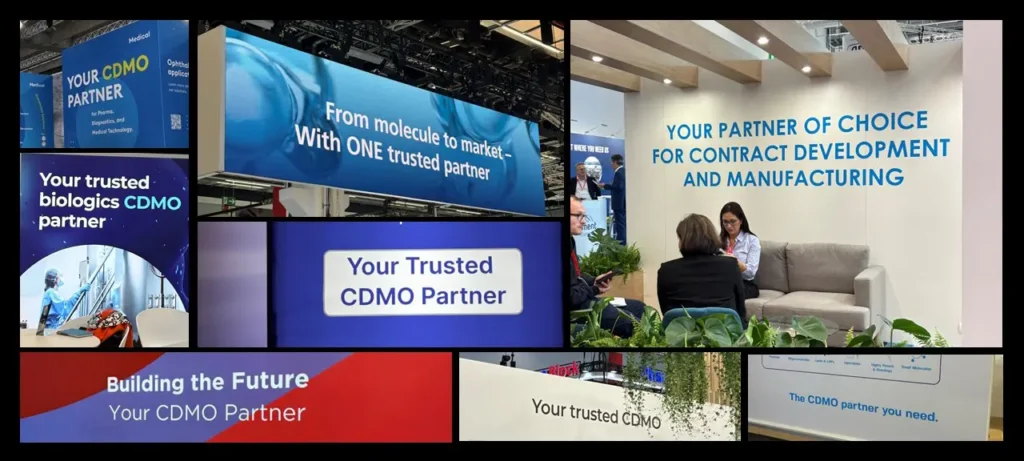
We noticed that lots of CDMO stands at CPHI used generic ‘partner’ messaging but lacked clear value propositions that would help buyers understand what makes their partnership authentic. It felt like the word ‘partner’ had been stretched so thin it lost meaning. We also observed a common mismatch between what companies said and what they showed, like claiming to be ‘patient-first’ but showing no images of actual patients. Organisations that can align their visuals with messaging and move beyond generic claims to demonstrate real partnership qualities will foster a deeper connection with their audiences.
The need for clear and transparent communication reveals a broader trend that is rippling through both the pharma and nutraceutical markets at present. At a roundtable dinner we hosted on the second evening of CPHI, we explored how B2B marketers can build trust in an age of scepticism. One participant reframed the conversation brilliantly: “Are we in an era of mistrust – or is it an era of misinformation?” The distinction matters. In the pharma space, B2B buyers, patients, and other healthcare professionals aren’t necessarily sceptical – they’re interested in solutions but are often faced with information that is lacking in clarity and context.
Key takeaways for pharma marketers
So, what do these pharma trends mean for B2B marketing communications? Here are our key takeaways:
- Own your voice, unapologetically. As one colleague put it during our debrief: “Brands need to own their own voice, unapologetically. You can’t be everything to everyone.” In an industry where everyone claims to be a trusted partner, specificity wins. Generic positioning doesn’t differentiate – it disappears into the noise. The brands that will thrive are those with clear points of view, authentic voices and the confidence to stake their claim distinctly.
- Demonstrate, don’t just declare. Move beyond partnership rhetoric to demonstrated value. Using concrete details in brand storytelling can help build credibility in ways broad claims never will. They also help B2B buyers – who are evaluating multiple potential partners – understand what makes your approach genuinely different.
- Align visual identity with purpose claims. If you say you’re patient-first, show patients. If you claim to be purpose-led, tell human stories. The visual disconnect we saw at CPHI represents missed opportunity for emotional engagement and differentiation.
- Address uncertainty honestly. In an era of VUCA, buyers are looking for partners who can clearly and openly articulate how they’re managing volatility and building resilience. Tackle uncertainty head-on with positive solutions. Show how you’re building resilience through geographic diversification, dual sourcing, strategic inventory and robust risk mitigation frameworks.
Final thoughts
CPHI Frankfurt 2025 revealed an industry at an inflection point. Therapeutic innovation is accelerating, geopolitical uncertainty is reshaping supply chains and the partnership model is evolving from transactional relationships to strategic collaboration. For B2B marketers, these shifts demand a fundamental rethink of communication strategies. The generic claims that once sufficed – ‘trusted partner’, ‘quality-focused’, ‘patient-centric’ – no longer differentiate. The future belongs to brands that communicate authentically and specifically and align their visual identity with their purpose. As one speaker at CPHI put it: “The future of global pharma manufacturing will not wait for us to catch up – we must lead it, shape it and rise to meet its complexity with courage, clarity and collaboration”.2
At BDB, we help pharma brands communicate with the clarity, authenticity, and strategic insight that today’s market demands. If you want to achieve more with your communications, let’s talk.
- CPHI 2025 Presentation: Clinical Innovation in Obesity: The Next Five Years in Obesity Development. Aurelio Arias, Director, EMEA Thought Leadership, IQVIA. ↩︎
- CPHI 2025 Presentation: Global Pharma Manufacturing in Flux: Adapting to a New Era of Complexity. Frances Zipp, President & CEO, Lachman Consultant Services, Inc. ↩︎
- CPHI 2025 Industry webinar: Supply Chains Under Pressure: Building for Strength, Not Just Speed. ↩︎