Menu

TheValue on InvestmentIssue

The Value on Investment Issue

A new lens on B2B marketing value

Editor’s note

The ROI trap: when return becomes a restriction

Many B2B marketers are caught in the ROI trap. Picture a marketing director frantically tweaking PPC campaigns to hit quarterly lead targets while that bold brand campaign sits perennially on the back burner. Sound familiar? The obsession with showing immediate returns often restricts marketing’s potential. Brand initiatives get sidelined. Bold ideas get shelved. The goal becomes hitting quarterly numbers rather than creating lasting value.

In one survey, 85% of B2B marketers said lead generation was their top priority, while only 65% focused on brand awareness.3  It’s understandable — ROI is the language of the boardroom. But this over-reliance on short-term tactics can backfire. When brand health is ignored, future results suffer.

A 20-year study by Les Binet and Peter Field found that long-term brand campaigns in B2B were nearly twice as effective as short-term ones.4 Brands that invest steadily in reputation outperform those who chase short-term wins.

Myth: brand value can’t be measured
Reality: its impact shows up in loyalty, lead efficiency and long-term growth

Over time, relying solely on activation tactics results in diminishing returns. Meanwhile, competitors who’ve nurtured brand equity become harder to beat. One might call it ROI myopia — a mindset so focused on near-term return that it blinds us to longer-term value.

To be clear, this isn’t a call to throw ROI out the window. It’s about expanding what ‘return’ means. Too many B2B teams are shouting in the dark — under constant pressure to deliver, yet under-investing in what would drive long-term growth. The ROI trap keeps us busy, not building. Escaping it starts with calling it out. If you recognise the pattern, you’re not alone. Naming the short-term obsession for what it is —a restriction— is the first step to breaking free. And there is a smarter path: one that satisfies short-term needs while creating lasting value. It starts with shifting from an ROI mindset to a VOI one and unlocking marketing’s full potential.

The long game: embracing value on investment

B2B marketing should be seen as a growth engine, not a cost centre. VOI means evaluating marketing by its long term impact rather than just short-term gains. That includes outcomes like increased awareness, customer trust, share of voice and market differentiation. You can’t always measure these in a single quarter’s KPIs, but they are real value that, given time, translate into sales and profit.

The widely cited 60/40 rule (60% brand, 40% activation) exists for a reason. In B2B, some suggest 70/30 is more appropriate5 but the principle stands: both are needed and investing in brand actually makes your lead-gen more effective. When you adopt VOI, you’re essentially institutionalising that balance. You allocate, say, a fixed portion of budget to brand campaigns (no matter what), treating it as non-negotiable investment rather than discretionary spend.

To make VOI tangible, let’s introduce a simple framework. Think of it as an ‘investment maturity ladder’:

This ladder helps marketers understand where they are and where they could go. Even small shifts, like ringfencing budget for brand health or tracking brand KPIs, can move a team from short-term firefighting to long-term value creation.

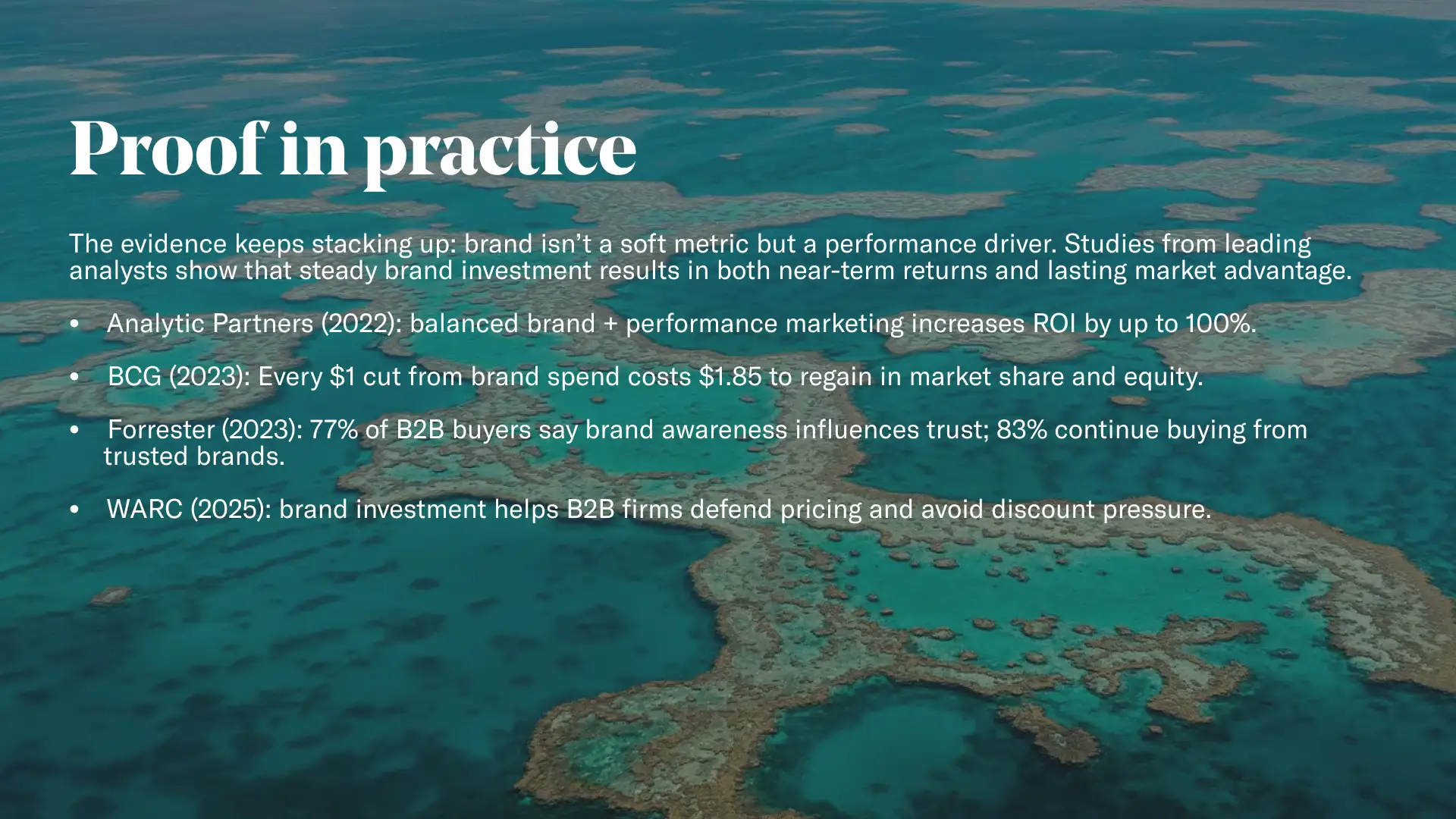
Crucially, embracing VOI is not a naive ‘marketer’s fantasy’ that ignores business realities. It’s backed by evidence that a balanced approach yields better results even in the relative short run. The ROI Genome study by Analytic Partners found that performance-only strategies often lower ROI by 20–50%, while brands with a balanced mix saw ROI increase by up to 100%.6 Too much short-term focus can limit long-term growth. Steady investment in brand strengthens both. The short and long term aren’t opposites but rather reinforce each other. Strong brands make sales easier, while successful campaigns create fuel for future investment. It’s a cycle of value — but only if you play the long game.

Quantifying the intangible: proving VOI in the boardroom

Even the most forward-thinking marketing teams will struggle to embed VOI if they can’t prove its impact. This is where many B2B marketers can feel stuck: they understand the importance of long-term investment but lack the frameworks and language to articulate that value to leadership.

The challenge with VOI isn’t measurability but methodology. Most ROI-centric dashboards capture short-term activity, not the deeper indicators of value, such as brand strength, market sentiment or future revenue potential.

That’s why we need a more balanced scorecard. Leading marketing teams pair short-term results (MQLs, conversions, pipeline velocity) with longer-term indicators: share of voice, brand health, customer lifetime value. These don’t always deliver instant gratification, but they build over time and are strong signals of future growth.

Leading indicators:

Brand awareness, consideration, share of voice (SOV), net promoter score

Lagging outcomes:

Inbound enquiries, win rates, average deal value, customer retention, margin growth

By showing how these metrics correlate, marketers can prove that long-term brand investments influence business performance. For instance, higher share of voice has been linked to increased market share, whereas strong brand salience can shorten sales cycles.

Of course, the boardroom needs more than a correlation. This is where storytelling comes in. Reframing the value of marketing often means translating softer signals into commercial outcomes. Instead of ‘This campaign raised awareness’, say ‘This campaign contributed to a 12% rise in inbound enquiries and a 5% increase in win rate.’

This kind of language matters. The goal isn’t just internal buy-in, it’s building a narrative that elevates marketing beyond lead generation and to speak in a way that resonates with finance, sales and the C-suite.

CFO Q&A cheat sheet

How to answer the hard questions

Bringing VOI to life is more than a measurement challenge. It’s a messaging one. Equip your team with the right metrics and the right narratives and you’ll start to change how value is perceived at the highest level.

Educate your leadership that marketing performance isn’t either leads or brand, but both together. Over time, as you report ‘brand equity up 5% this quarter’ alongside ‘pipeline up 10%,’ the narrative will shift.

Ultimately, proving VOI is about confidence and consistency. Don’t hide the intangible; highlight it but tie it to the tangible. Use surveys, attribution models and even external benchmarks to put numbers to things like trust and reputation. And be patient. You’re changing the conversation and that doesn’t happen overnight. The encouraging news is that when marketers take this on, they often gain newfound respect internally. Suddenly you’re not just the ‘lead-gen team,’ you’re the guardians of the brand and stewards of future revenue. Armed with data and a clear story, you can walk into the boardroom and show exactly why marketing belongs on the investment side of the ledger and back it up with proof.

From cost centre to growth engine: marketing’s role in value creation

For VOI to stick, it needs to show up across the business. That means marketing must do more than make the case for brand. It must prove its role as a driver of strategic value.

This shift starts with visibility. Too often, marketing is treated as a downstream function: the team that communicates, not the team that shapes. But marketers are closest to the customer context. They spot early signals, track shifting behaviours and carry the voice of the market. That gives them an essential role in future-proofing the business.

This is what happens when you fully activate VOI internally: marketing becomes the translator between brand and balance sheet.

When marketing operates upstream, its impact is often harder to see but that’s where much of its value lies. It brings commercial clarity to early decisions, aligning innovation, positioning and customer relevance long before a product reaches the market. Yet because these effects are indirect, they’re often overlooked or under-credited.

Take innovation. When marketers feed insight from emerging customer needs into R&D, they influence what gets prioritised and produced. They’re not just promoting the solution but helping define it. That’s VOI in action.

As ideas move downstream, that same strategic input shapes pricing, messaging and market entry. A brand with a clear, trusted narrative can command stronger margins and faster uptake. When marketing works hand in hand with commercial teams to position value, it creates results that extend far beyond awareness metrics.

And at the organisational level, brand reputation amplifies confidence, attracting talent, investors and partners alike. When marketing builds coherence and clarity into how a business shows up in the world, it strengthens performance from the inside out.

Where VOI creates value beyond comms

Innovation:

Market insight guiding product decisions

Pricing:

Brand equity protecting premium positioning

Culture and reputation:

Strategic clarity attracting talent and partners

Marketing earns influence by proving its value in the language the business speaks. Bring evidence to every discussion. Show impact in commercial terms. Turn brand from a cost into a catalyst and make VOI the common currency of growth.

The Value on Investment Issue

The VOI playbook: five ways to embed long-termism

Embracing VOI is not just a campaign-level decision but a cultural one. And embedding that thinking into your team, your metrics and your planning cycles is what separates the occasional brand investment from a long-term value approach.

Here are five practical steps to help make the shift from short-term fixes to lasting impact:

Closing thought

The challenge, and opportunity, for B2B marketers today is to prove that value isn’t just what’s earned this quarter but what’s nurtured and layered over time. The brands that lead with this mindset are already changing how marketing is perceived, from a reporting function to a growth driver.

As this edition shows, Value on Investment is a discipline that rewards consistency, clarity and conviction. So take these ideas back into your teams, your plans and your boardrooms. Test them. Share them. Build on them. Because the more we speak the language of value, the stronger the case for marketing’s place at the heart of business strategy.